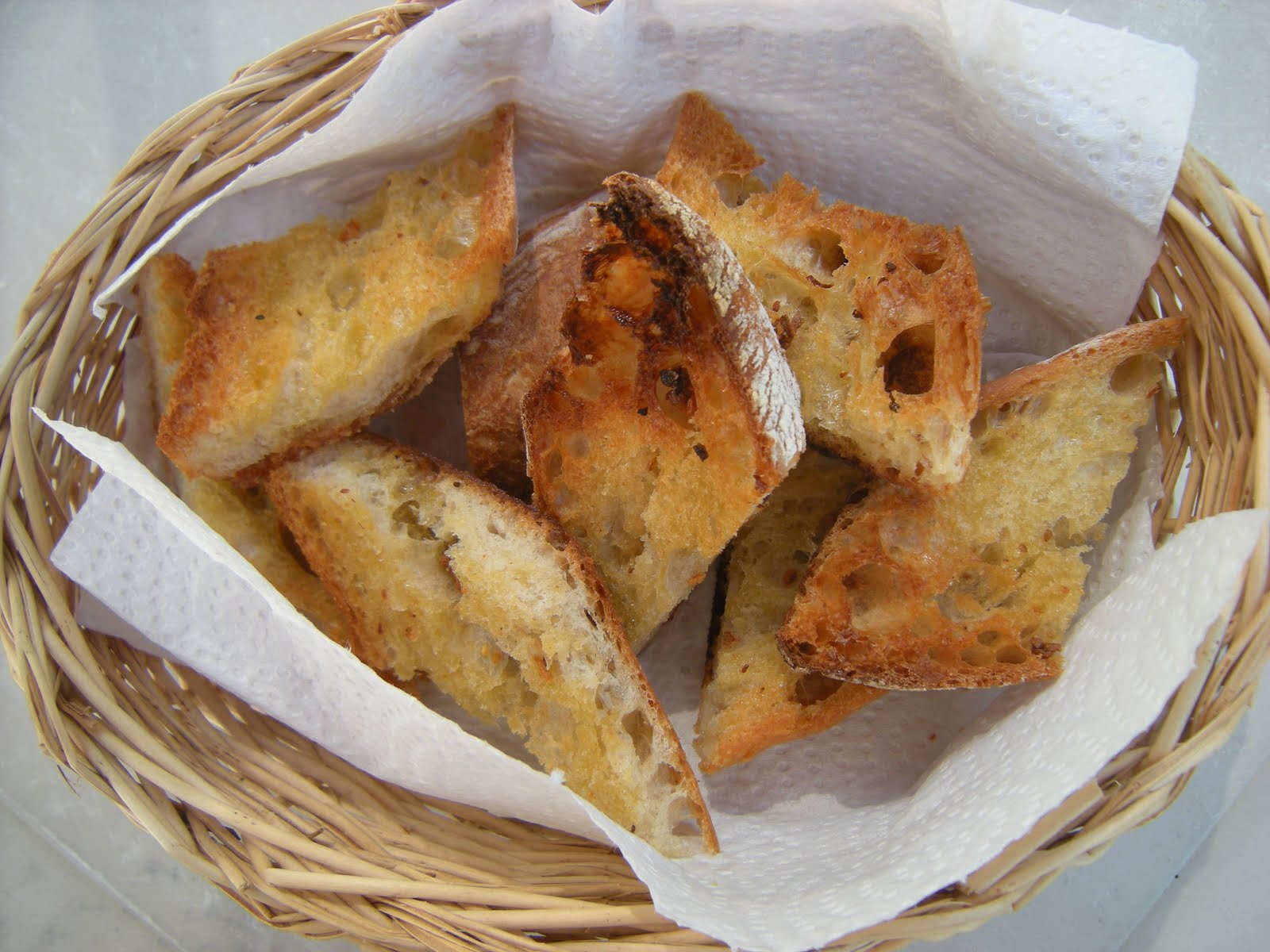
The oil came from a jar of sundried tomatoes. I buy jars of sundried tomatoes, mushrooms, peppers and artichokes from Aldi. When I've finished all the vegetables I use the oil in dressings etc. It's full of flavour. Too good to throw away.
Sunday, 17 April 2011
Ways with Stale Bread - 1
The oil came from a jar of sundried tomatoes. I buy jars of sundried tomatoes, mushrooms, peppers and artichokes from Aldi. When I've finished all the vegetables I use the oil in dressings etc. It's full of flavour. Too good to throw away.
Friday, 18 February 2011
Why?
Heinz have launched a new Fridge Pack. At 1kg it holds approximately the same amount of beans as 2 1/2 standard tins, and its purpose is to provide families with beans 'on tap'*.
However I don't get it. If a consumer finds it difficult to eat her/his way through 410g of beans at one sitting, why would s/he opt for 1 kg instead? Especially if there was no savings per kg to be made!
I don't know what kind of plastic the jar is made of, but even if it is recycleable, facilities for doing so are much less common than for aluminium cans. My guess is that most of them will end up in landfill sites.
Besides, what's so difficult about decanting the remains of a tin of beans into a sealable container and storing it in the fridge? Just as effective and a lost less waste.
* Paula Jordan, Marketing Director at Heinz
However I don't get it. If a consumer finds it difficult to eat her/his way through 410g of beans at one sitting, why would s/he opt for 1 kg instead? Especially if there was no savings per kg to be made!
I don't know what kind of plastic the jar is made of, but even if it is recycleable, facilities for doing so are much less common than for aluminium cans. My guess is that most of them will end up in landfill sites.
Besides, what's so difficult about decanting the remains of a tin of beans into a sealable container and storing it in the fridge? Just as effective and a lost less waste.
* Paula Jordan, Marketing Director at Heinz
Sunday, 21 November 2010
Aluminium Foil
Bauxite, from which aluminium is smelted, is mined in open cast pits in countries such as China, India, Guinea and Kazakhstan. Thousands of tons of waste rock are produced, villagers are often displaced and rivers and soil are polluted. Large amounts of energy are expended, almost half of which is generated from fossil fuels, contributing to the greenhouse effect.
So reducing, reusing and recycling are all the more essential. I try not to use too much foil and never throw it away until it's too torn or holey for anything but the recycling bin.
Today I spotted this 100% recycled kitchen foil. It may have been around for some time but this is the first time I've seen it. It's made from car components, guttering, railway sidings, cookware, stadium seating and scraps of industrial cables! The aluminium is heated to over 650 C . The impurities are burned off and the molten metal is filtered, poured and rolled to produce thin sheets. Recycled aluminium uses 80% less energy to produce than from new.
This roll should last me for a while but I know where to look when I eventually need some more.
Saturday, 23 October 2010
SOS Fruit
Not wanting to waste them I pressed them through a metal sieve to extract the juice. It was a bit strong on its own but was perfect when diluted half and half with tonic water.
My husband then fried some tired looking apples to go with our pork chops for dinner.
Tomorrow I must remember to look out a recipe for a cake involving pears.
Friday, 15 October 2010
Blog Action Day 2010 - Water
Do you keep the tap running when you brush your teeth?
If the entire population of England and Wales kept their taps off we could save 180 megalitres of water every day! This would be enough to supply nearly 500,00 houses.
I am constantly amazed by how even the most insignificant individual action can have such a tremendous effect when replicated across the population.
Don't let anyone tell you that what you do, or fail to do, doesn't matter.
If the entire population of England and Wales kept their taps off we could save 180 megalitres of water every day! This would be enough to supply nearly 500,00 houses.
I am constantly amazed by how even the most insignificant individual action can have such a tremendous effect when replicated across the population.
Don't let anyone tell you that what you do, or fail to do, doesn't matter.
Tuesday, 8 June 2010
REDUCE, REUSE, ... recycle!
So the coalition government is going to scrap Labour's proposed tax on landfill rubbish in favour of credits for recycling.
Apart from my regret that people should need to be bribed to recycle, as opposed to considering it their civic duty to do so, I am not persuaded that encouraging the purchase of (over)packaged goods, in the anticipation of being rewarded for throwing most of it away, is a step in the right direction. They obviously haven't realised that we should be 'reducing' and 'reusing' first.
Perhaps I should write to Mr Pickles and remind him of this?
Apart from my regret that people should need to be bribed to recycle, as opposed to considering it their civic duty to do so, I am not persuaded that encouraging the purchase of (over)packaged goods, in the anticipation of being rewarded for throwing most of it away, is a step in the right direction. They obviously haven't realised that we should be 'reducing' and 'reusing' first.
Perhaps I should write to Mr Pickles and remind him of this?
Sunday, 14 February 2010
Buttering us up?
I've been drawn to the latest Lurpak ads, which advocate a return to an 'old fashioned' way of life - homecooked food, quality over presentation, the celebration of simple pleasures, the virtue of patience and zero waste. I love them!
Unfortunately for Lurpak they have not persuaded me to switch to their brand. I'll stick to my local butcher who sells a very acceptable variety wrapped in environmentally friendly paper.
Surprisingly, although Lurpak's website features a tempting selection of recipes, it says nothing about the recyclability of their packaging.
Labels:
baking,
cakes,
food,
good housekeeping,
local shops,
plastic,
recipes,
zero waste
Subscribe to:
Posts (Atom)